![305073553_499374155352633_936760715116756730_n.png]](https://knowledge.neuronsinc.com/hs-fs/hubfs/305073553_499374155352633_936760715116756730_n.png?height=24&name=305073553_499374155352633_936760715116756730_n.png)
While our core predictive models, Attention, Engagement, and Memory provide an aggregate view of your asset's impact, Start and End metrics allow you to analyze these dimensions across specific time windows.
This duration reflects typical real-world viewing behavior in environments such as social feeds, retail displays, and out-of-home advertising, where consumers rarely engage with a static visual for more than a few seconds.
Neurons AI evaluates the creative impact of static assets across a standardized 5-second exposure window. By isolating the first and last two seconds of exposure, these metrics provide granular insight into how a viewer’s cognitive response evolves from the initial "hook" to the final takeaway.
Metric Definitions
1. Start/End Attention (Image & Video)
- Start Attention: The percentage of attention directed toward a specific Area of Interest (AOI) during the first 2 seconds of exposure.
- End Attention: The percentage of attention directed toward the AOI during the final 2 seconds of exposure.
2. Start/End Focus (Image & Video)
Start/End Focus: A measure of the concentration of attention based on the predicted heatmap. High focus indicates that attention is narrowed onto specific elements, whereas low focus suggests a more dispersed distribution.
Start Focus heatmap End Focus heatmap


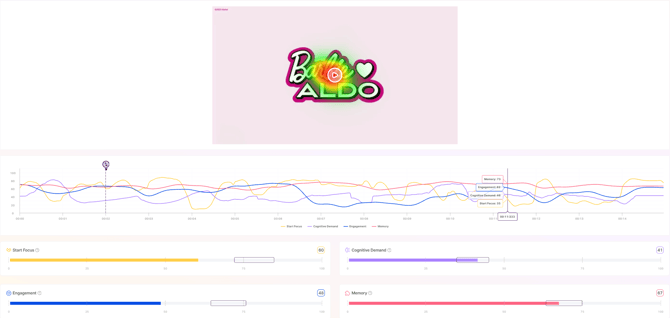
3. Start/End Cognitive Demand, Engagement & Memory (Video Only)
For video assets, the Cognitive Demand (visual complexity), Engagement (emotional resonance) and Memory (likelihood of encoding) scores are also available as Start and End metrics. This allows you to track whether your video successfully builds emotional momentum and leaves a high-impact brand impression before the viewer exits.
The Science Behind the Models
The Start and End metrics are powered by distinct deep-learning prediction models. Unlike the images total attention model that average performance over the full 5 second exposure window, these models are specifically trained to predict patterns in the eye tracking during early vs. late exposure (first 2 and last 2 seconds).
- Training Data: Our models are built upon a proprietary dataset gathered over 13 years, encompassing over 100 billion data points. This includes high-quality data from eye-tracking - fixations, fixation duration and time to first fixation.
- Image Models: The Start Attention image model is trained specifically on eye-tracking fixations from the first 2 seconds of exposure. The End Attention model is trained on the final 2 seconds.
- Video Models: For video, these metrics are derived from our frame-by-frame attention prediction model. The metrics aggregate the fixations across all frames within the first and last 2-second segments of the creative.
A note on Fixations vs. Gaze Points
A critical distinction in how Neurons AI predicts attention—specifically within the narrow 2-second windows of Start and End metrics—is our reliance on fixations rather than raw gaze points.
The Problem with Gaze Patterns
The human eye is constantly in motion. However, just because the eyes move over a specific area on their way to a new location does not mean that information is being noticed or processed. For instance, when moving your eyes from one corner of a screen to another, an eye-tracker captures "in-between" positions.
We do not count these transit points as attention. These points have no measurable effect on human attention, cognition, or emotion. Models that rely on raw gaze points are prone to false positives, incorrectly suggesting that a user "looked" at an element when their eyes were simply caught between two meaningful points of focus.
The 60ms Fixation Standard
Neurons AI operates with fixations. We define a fixation as a moment when the eyes have rested on a region for a sufficient duration to trigger brain processing. This threshold is approximately 60ms, or three consecutive gaze points of 20ms each within a small region.
By training our AI models only on these meaningful fixations, we ensure that the "Start Attention" score reflects true cognitive engagement rather than accidental eye movement. This precision is especially vital for mobile and small-screen optimization. Our research in this area, conducted in collaboration with Meta, resulted in both a GPL patent and a published academic paper in Frontiers in Neuroscience (view paper).
Why These Metrics Matter
The distinction between the beginning and the end of an asset is critical because consumer behavior varies significantly across different media channels.
Initial Impact (The First 2 Seconds)
In high-velocity environments such as social media, out-of-home (OOH) advertising, and retail, the first two seconds are often the only window of exposure. Research from JCDecaux suggests that ads in these environments rarely receive more than 2 seconds of total attention.
- Application: Use Start Attention to ensure that brand identifiers or key messages are noticed immediately. If the Start Attention on your brand logo is low, the viewer may scroll past or drive by without ever associating the content with your brand.
Lasting Impression (The Final 2 Seconds)
The end of an asset is fundamentally linked to memorability and conversion. The final moments of a video or the final glance at a static ad form the lasting impression in the audience's mind.
- Application: High End Attention and End Memory scores are strong indicators of an ad’s potential for brand lift. For videos "end cards" are crucial for action driving ads; they serve as the final prompt for the user to take action. Ensuring low Cognitive Demand at the end of an asset can help ensure the CTA is processed clearly without mental fatigue.
The Insights Page summarizes these metrics for all of your assets, giving you a clear view of how attention, focus, and memorability change from the first impression to the final takeaway.
Best Practices & Key Takeaways
- Audit Your "Hook": For social and OOH, prioritize Start Attention and Start Focus. If these scores are low, consider simplifying the visual layout to guide the eye more quickly to the AOI.
- Optimize for Conversion: For longer-form video, monitor the End Memory score. A drop-off in the final 2 seconds suggests the brand message is getting lost, which may negatively impact your ROI and brand recall.
- Manage Complexity: Use Cognitive Demand to balance your creative. High complexity might be effective for grabbing attention (Start), but it should generally be reduced at the point of the Call to Action (End) to facilitate ease of processing.